

The creative is ready. The landing page is with product. Support has last week’s FAQ. Your campaign owner asks: can we release at the agreed time?
Only when those pieces tell the same story. A sportsbook campaign needs an approved source for its claims, a named approver for each asset and a clear decision when something remains unresolved.
Start with five items: creative, full offer terms, landing page, FAQ and support briefing. Review them together. A changed eligibility rule can reopen every asset, including yesterday’s approved artwork.
Work backwards from release
Agree an approval cut-off before scheduling production. Media bookings, regulatory review, deployment and support preparation can require different lead times. A deadline one hour before kick-off may already be too late.
For Nigerian campaigns, record the date and WAT explicitly. Confirm the source time zone before converting fixture times. Name the jurisdiction, channel, eligible audience, qualifying action, exclusions and destination. Missing information is a question for the offer owner, not an invitation for the writer to improvise.
Build one release record
Use your existing tracker rather than another approval channel. Each entry needs the source version, asset owner, approver, dependency, deadline and GO or HOLD decision. Replace department labels with people who can actually resolve the question.
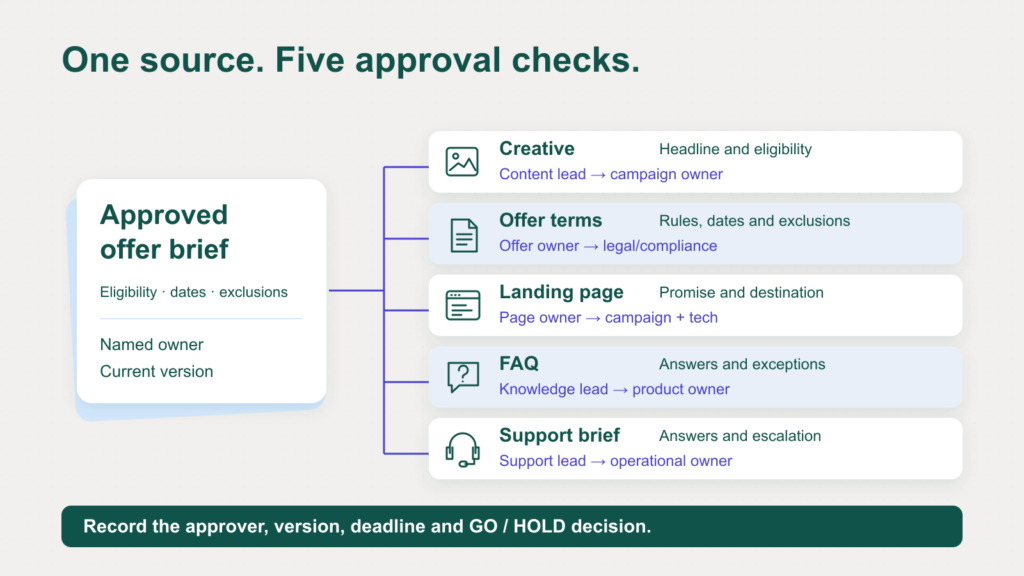
For our fictional Nigeria-facing football campaign, the demonstration brief specifies eligible adult new customers only, excluding existing accounts. Full conditions must accompany the destination. No reward amount, odds or live promotion is invented. This is an illustrative production exercise, not a client campaign.
1. Creative: does the headline match eligibility?
The content lead works from the current offer brief and authorised campaign assets. The campaign owner approves message accuracy, with compliance review where required. HOLD if the artwork includes existing customers while the brief excludes them. Correct the main claim; do not expect small print to repair a contradictory headline.
2. Terms: are the commercial rules settled?
The offer or product owner supplies the controlled terms. The authorised legal or compliance reviewer clears the applicable wording. Confirm mechanics, exclusions, dates and market scope before drafting dependent assets. HOLD while a material rule remains disputed. A production deadline does not transfer offer approval to the content team.
3. Landing page: can the destination support the promise?
The page owner uses the same brief and terms. The campaign owner checks consistency; technical and compliance owners retain their respective approvals. Open the actual destination on mobile and test its links. HOLD if eligibility differs, conditions are inaccessible or the promised action is unavailable. A screenshot cannot confirm a working journey.
4. FAQ: are the difficult answers agreed?
The content or support-knowledge lead drafts from approved terms and feature documentation. Product confirms accuracy. Cover eligibility, timing, exclusions and what happens when an expected feature is unavailable. HOLD unanswered points for a named owner. Do not turn an assumption into a customer-facing answer simply because it sounds reasonable.
5. Support briefing: who handles an exception?
The support lead prepares agents using the approved FAQ, campaign window and escalation route. The operational owner confirms readiness. Check that agents can find the current answers and identify the person handling exceptions. HOLD affected activity where that preparation is missing. Uploading a document does not prove the team received it.
Feature conditions belong in the brief
MSport’s Nigeria Cashout help page illustrates why the source matters. Rechecked on 4 November, it says availability is not guaranteed and that price changes or market suspension can prevent a request succeeding.
Those limitations are present in the documentation. This observation does not establish a campaign omission, product failure or customer confusion. No account or betting test was conducted.
When promoting a feature, ask product which conditions belong beside the claim and which need fuller explanation. Keep the source URL and review date with the copy. A feature name alone cannot justify an unconditional promise.
Content sign-off is not regulatory clearance
ARCON’s published Nigerian vetting procedure says advertisements within the vetting category should not be exposed before the relevant approval certificate is received. Keep that clearance separate from internal content approval.
Your qualified compliance owner must confirm current requirements for the jurisdiction, channel and promotion. Platform acceptance does not establish gaming authorisation. Record the approval reference, covered placement and exact version.
Refer material changes back to the authorised reviewer; earlier clearance should not be assumed to cover revised claims.
Close on the exact files
Put the final creative beside the live destination. Compare eligibility, dates, time zone, qualifying action, exclusions and access to full conditions. Check mobile display and working links. FINAL in a filename does not identify what the approver actually reviewed.
Record GO for specified versions and placements, or HOLD against a named dependency. Save the approver, timestamp and source version. If a rule changes, recheck the connected assets rather than assuming a previous sign-off survives the edit.
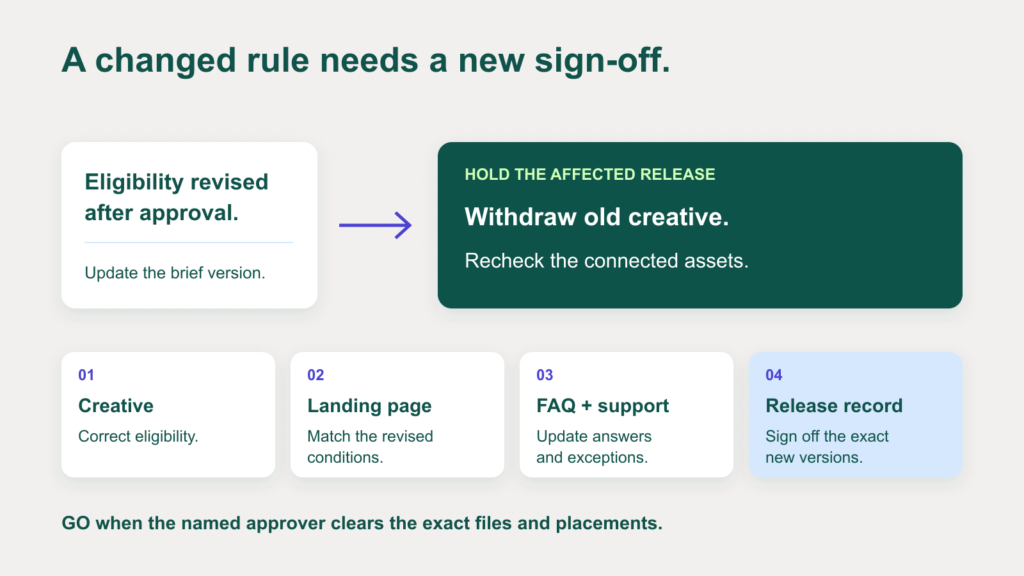
Set one route for late changes. If the offer owner revises eligibility after creative approval, clearly identify the affected files, withdraw obsolete versions from the production folder and notify the people using them.
Agree who can stop scheduling while the correction is checked. Otherwise, an accurate new brief can coexist with an old asset that still looks approved to the person preparing publication.
After release, record corrections, recurring support questions and approval delays. Use them to improve the next brief, not as automatic evidence of additional revenue.
Give production a defined owner
Your team owns the offer, product rules, legal clearance and publishing permission. iGW can own an agreed production package: brief, channel copy, visuals, FAQ draft and release checklist, checked against your approved materials.
Agree quantities, revisions, responsibilities and dates around your existing team. Share the launch date and the assets still awaiting approval.