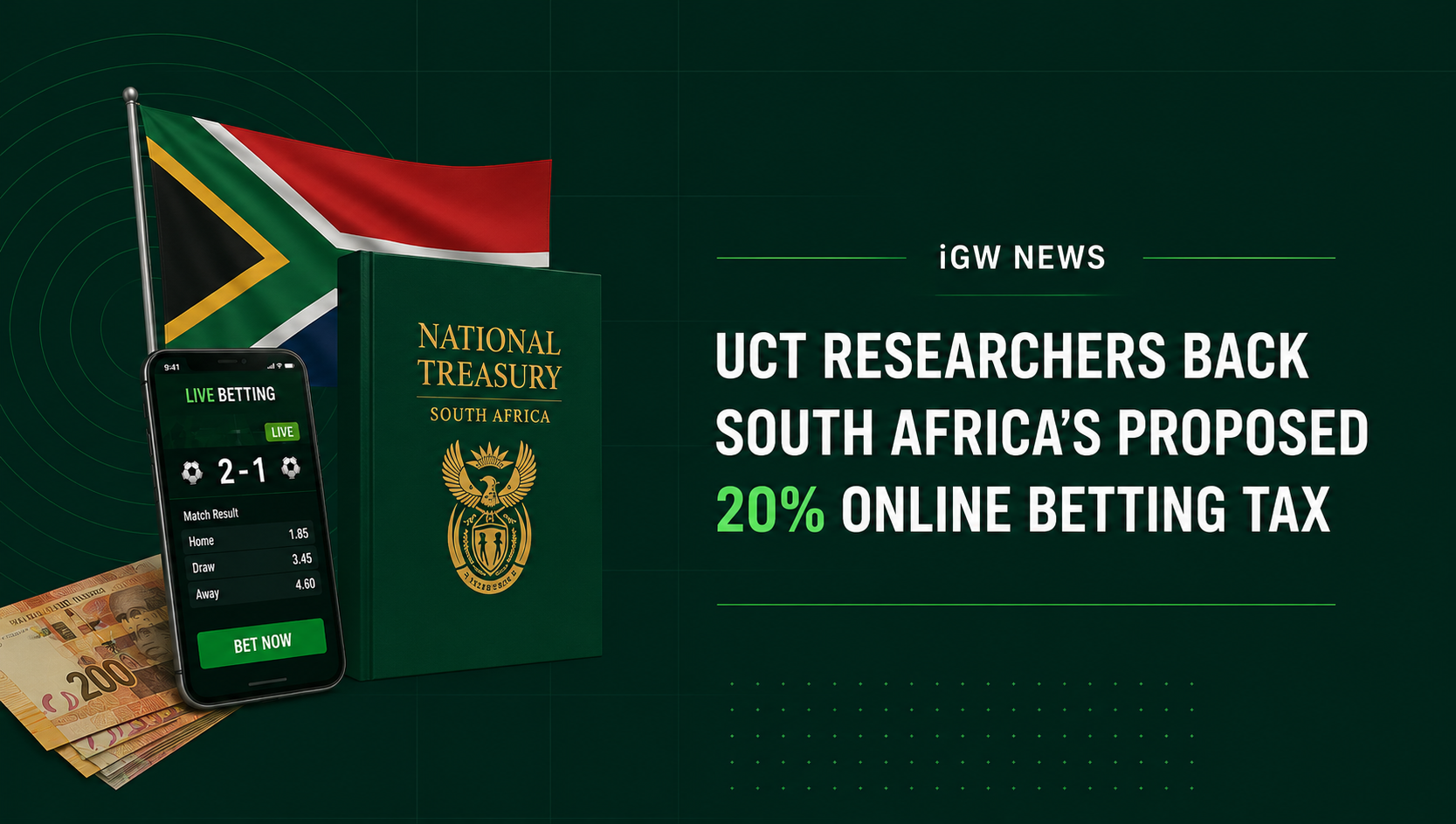
Researchers from the University of Cape Town are supporting South Africa’s proposed 20% tax on online gambling revenue, arguing that the country’s betting boom is causing financial and social harm. Introduced by South Africa’s National Treasury, the proposal would taxes gross gambling revenue in addition to existing 6% to 9% provincial taxes.
Academics from the university’s Research Unit on the Economics of Excisable Products said the intervention is necessary as online and retail betting activity expand rapidly nationwide. According to the researchers, online and retail betting tripled between the 2021/22 and 2024/25 financial years, while total gambling expenditure doubled over the same period.
The academics, Dr Nicole Vellios, Mxolisi Zondi and Professor Corné van Walbeek, outlined their position in an article published in Econ3x3. Vellios stated:
“The gambling industry has strongly criticised Treasury’s proposal, first published in a discussion paper in November 2025. This is hardly surprising. We have seen a similar pattern in other sectors, including tobacco, alcohol and sugar sweetened beverages. The supposed economic benefits of these industries are loudly promoted, while the social, health and financial costs are conveniently ignored.”
Betting Growth Triggering Public Health Concerns in South Africa
The debate around gambling taxation in South Africa has moved from revenue generation into concerns around consumer harm and economic pressure on households. A 2025 survey by Old Mutual found that 52% of South Africans earning more than R8,000 monthly engage in gambling activities. Participation was highest among men and people aged between 30 and 49 years old.
Three quarters of respondents said they used online betting or gambling applications, while one quarter reported financial difficulties linked to gambling activity. Mxolisi Zondi commented:
“The rapid expansion of online betting, fuelled by relentless marketing and frictionless digital access, represents a significant public policy challenge. A tiny fraction of gamblers win large sums, but most lose. The industry functions as an arbitrary and highly asymmetrical income redistributor, where, in aggregate, resources tend to flow from poorer households to corporate operators.”
This framing is important because it reflects a growing argument among policymakers and public-health researchers that betting is now viewed more as a revenue source than entertainment in Africa.

True Debate Around Gambling Accessibility
One of the more revealing parts of the discussion is the focus on digital accessibility from the researchers. The academics argued that the proposed tax should apply to both online and retail betting to prevent gamblers from simply shifting behaviour between channels. This shows how deeply integrated betting has become within South Africa’s digital economy.
Online betting platforms reduce friction significantly, with registration taking minutes and players accessing instant deposits or payouts. The researchers estimated that South Africans wagered around R1.5 trillion during the 2024/25 financial year, although the figure includes recycled payouts reinvested into bets. Van Walbeek also spoke on the research outcomes:
“While it illustrates the scale of gambling activity, it also reflects the dynamic that payouts are not typically withdrawn in full by players, but are instead frequently reinvested into further betting. Industry marketing strategies actively reinforce this behaviour, commonly targeting customers immediately after a payout with incentives, such as exclusive offers, to encourage continued play.”
This is one of the least understood mechanics within digital betting ecosystems. Gross wagering figures often appear enormous because betting cycles repeat inside operator platforms before money ever leaves the system.
Proposal Might Influence Other African Markets
South Africa's proposal is likely to attract attention across other African gambling markets facing similar regulatory pressures. Governments want stronger tax revenues from the sector, while public-health groups demand tighter controls around advertising and problem gambling. Operators, meanwhile, warn that excessive taxation could strengthen illegal and offshore gambling markets without improved compliance systems.
The researchers themselves acknowledged that taxation alone would not solve gambling-related harm. Vellios added:
“Increasing tax rates by 20% without strengthening compliance is unlikely to yield the expected revenue gains. The South African Revenue Service should therefore explore and mandate appropriate technologies to enhance monitoring and enforcement.”